Costa News Spain Breaking News | English News in Spain.

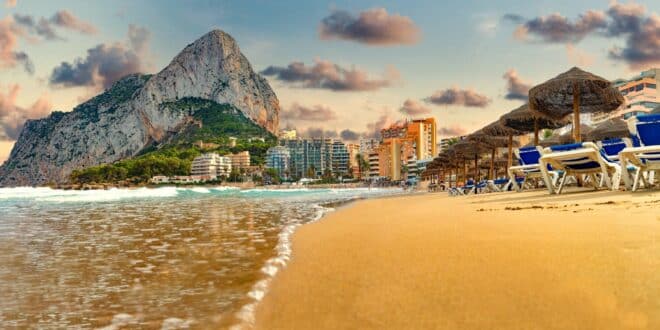
The first time I went to Calpe I thought I had walked into a different country. It wasn’t the sun that threw me off, or even the Peñon de Ifach looming over the bay like some monumental guardian – it was the voices.
English drifted from a bakery queue, Dutch from a nearby café, and German from a couple arguing amiably over sunscreen. Then someone greeted me in Valencian, and I realised this wasn’t confusion – it was Calpe.
It turns out that my ears were not exaggerating. Recently, the town reached a milestone that is truly astonishing: more than half of its residents are foreigners. More than 53%, to be exact – meaning Spanish residents are technically the minority in this stretch of the Costa Blanca. It is the only town in Spain that has more than 20,000 inhabitants to achieve this level of international mixture. But statistics don’t quite capture it. On the streets, you can feel it. Conversations switch between languages in the middle of sentences, and menus have three translations.
Calpe is no longer a sleepy town of fishermen. It now has a global pulse. And this shift has changed everything – not just the faces in its markets, but the entire logic of how it lives and breathes. For decades, the coastal towns of this region have thrived with a seasonal pulse: busy summers and empty winters. Calpe, however, has broken this cycle. They did not come to stay for two weeks; they stayed for longer. They needed schools. They also needed doctors, plumbers and yoga teachers. They did not disappear in October.
Even on a cold Wednesday in January you can find restaurants open and cyclists zipping past the promenade. The smell of freshly brewed coffee is wafting from the bakeries, which were once closed for the winter.
This constant pulse has ignited a quiet revolution. Its mild winters, combined with the mountainous backdrop of the town, make it an attractive destination for hikers and cyclists who want to escape northern cold. You see them every morning, groups in bright Lycra pedalling through the mist toward the Sierra de Oltà, the clatter of gears echoing against limestone cliffs. The air has a faint smell of tarmac, sea salt, and new asphalt.
It’s not all about sports. It’s about balance – a kind of comfortable coexistence between Spanish tradition and European convenience.


Every Thursday, there’s a language swap in the main plaza. The chatter from the tables is like music. Hiking clubs meet at dawn by the Peñon’s trailhead. At the market, you’ll hear some Russian when bargaining over oranges. Yet beneath this international blend, Calpe still hums with its Valencian roots – the smell of paella on a Sunday, the rhythmic thump of fiestas, the patience of fishermen mending nets by the port.
The success of this project is not without growing pains. In August, the density of people near the seafront is often overwhelming. Parking can be a nightmare. The council is tackling the pressures by implementing better waste management and greener transportation options. It has even banned beach smoking (which makes the air in the ocean cleaner and the sand a less cigarette graveyard). These aren’t glamorous reforms, but they signal something rare for a tourist town – long-term thinking.
Perhaps that is the real story. Calpe’s charm isn’t in pretending to be Spanish or international, old or modern – it’s in managing to be all of it at once. Yes, the Rock is immovable but the community beneath it adapts and changes like the tide. And on certain evenings, when the sun slips behind the Peñón and the sky turns a slow copper, you can’t help wondering if this small town on the Costa Blanca hasn’t quietly reinvented what Europe itself looks like – a place where nobody quite belongs everywhere, yet everyone belongs somewhere.
Peñon and Pink
You can’t really understand Calpe until you’ve climbed the Peñon. From afar, it looks manageable – like a giant’s knuckle rising from the sea. Close up, it is something entirely different. I can still recall my first ascent: the screech and smell of cicadas; the wind sprinkling grit on my face, while I held a rusted-out chain, thinking, perhaps foolishly “How hard could it be?”
The trail begins with a gentle winding path through rosemary and pine. There’s a point about halfway up where you hit the tunnel – a rough, unlit bore through solid limestone. The air is thick with the scent of stone and moist. The sun is shining brightly, but you are still a long way from the top. It’s steep, narrow, with lots of loose rocks. Yet every step brings a bigger view, until finally you reach the summit – 332 metres above the sea – where the world unravels in every direction. Altea sparkles in the south and Moraira in the north. Far below, the Mediterranean is like a sheet of polished glass.
This is logical. The rock was worn down by too many feet. Booking online is required, which can be either a minor inconvenience, or a victory for the environment, depending on how patient you are with bureaucracy. It is worth the effort. The Peñon isn’t just a climb; it’s a conversation with the landscape. The Penon is a conversation with the landscape. You’ll see gulls riding on thermals and, if you are lucky, a Kestrel hovering in mid-air, like a thought refusing to land.
Just across the road, Las Salinas offers the perfect counterpoint – horizontal calm after vertical effort. Salt lake shimmers like liquid pink or silver depending on the time of year and microorganisms. In the late afternoon, when the light hits it right, the reflection of the Peñón on that rosy water feels almost unreal, as if nature decided to play at being an artist.
Las Salinas was once used for the production of salt. It is now protected habitat and home to waders. The flamingos will be standing out in the shallows with pale feathers that are blushed. The soundscape here is delicate – soft wind, occasional car, and the odd squawk of a startled bird. It smells like tears drying.
Both the Peñon and the salt flats are fragile, so locals ask visitors to tread gently – stay on marked paths, keep voices low, and take your rubbish home. Respect is the key. It’s not rules. Remember, these landscapes have existed for a long time and will survive our noise, sunscreen and selfies if we treat them right.
And standing there between rock and water, you can’t help noticing how these two opposites – the towering vertical and the shimmering flat – define Calpe’s character. Calpe is built between two extremes, stone and sea. There’s also noise and quiet, old and modern. Which makes you wonder, as the flamingos lift off in slow pink arcs, whether balance is ever really still – or if it’s just the art of constant adjustment.
Bathing in history
You can’t help but smile when you hear that Calpe’s “Queen’s Baths” were never really baths. I went to the Queen’s Baths expecting marble pools with mosaics. Maybe even a faint echo from a long dead empress snoozing in the steam. Instead, I discovered rocky tide pools that were sunlit and rough, carved directly into the coast. Turns out, the Romans weren’t bathing here at all – they were farming fish.
The Baños de la Reina date back nearly two thousand years, a complex of stone basins connected by little canals where sea water flowed in and out. You can still see grooves for sluice gate if you stand on the edge. You can smell the salty seaweed if you crouch down low enough. This must have been the scent Roman workers would’ve known.
You can swim right next to those ancient cuts, where once mullet, bass, and other fish were fattened up for the tables of the Roman Empire. There’s something almost cheeky about that – the Mediterranean shrugging at time.
Just inland, the Old Town is a different story altogether – narrow lanes, worn steps, flashes of colour from painted walls and flags. The Torreó de la Peça stands sentinel, a reminder of the town’s medieval defences. Just beyond the shadow of this tower, a staircase painted in the Spanish flag attracts Instagrammers. Calpe seems to deliberately clash with the past, as if it refuses to decide which version of itself is to be presented.
A British couple was asking directions in Spanish, while locals were arguing about football. A mural of a woman’s face stretched across the wall, her eyes bright blue and slightly too large – the artist’s mark of modernity. Calpe is a miniature of this mix and layering: ancient engineering beneath your feet, street art above, and accents that bounce off the stone.
The relationship between the past, present and future is more than just aesthetics. The Romans made their fortune from salt and fish. Calpe still trades in both. From the Baños to the fish market, the same sea provides. It’s change disguised as continuity. And maybe that’s why this town feels so grounded – its roots aren’t in nostalgia but in persistence.
Freshest Catch
You can feel Calpe’s pulse by going to the port around five in the afternoon. The fishing boats are returning just as the light is beginning to soften, and their engines are grumbling. Diesel, salt and wet cordage fill the air. It’s loud, messy, and completely unromantic – which is exactly why it’s perfect.
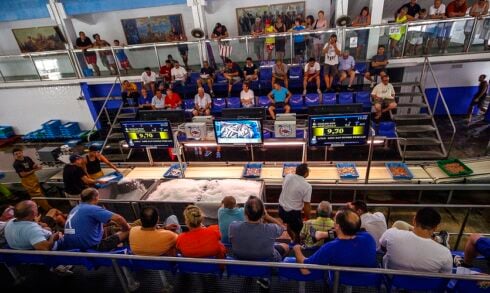
The daily fish auction starts at La Lonja. Fishermen unload crates filled with gamba, dorada and squid. Buyers watch in the glass gallery while their fingers flicker on electronic pads. The speed of it is astonishing – bids flash, numbers change, and within minutes, today’s catch is already spoken for. You can hear the thuds of crates and the scraping of metal against tile below.
The visitors can watch but they are kept well out of your way. After the beach, restaurants at Cantal Roig fire up their grills. You can even eat the fish that was unloaded an hour ago if you time your meal right.
Calpe doesn’t pretend. Calpe is real. It sweats. The food is better than what it looks like because it’s not polished for tourists. The prawns and arroz are both sweet and scarlet. Eat with your hands, wipe your mouth on a napkin, and watch the sky turn from gold to violet over the Peñón.
And maybe that’s the perfect ending to a Calpe day – not the climb, not the history, but the table. Sitting there, salt on your lips, sun on your skin, watching boats bob against their reflections, you realise that this small town manages to be ancient and modern, foreign and familiar, noisy and peaceful all at once, as if the Peñon itself breathes out a rhythm that everyone unconsciously follows – and isn’t that, in its quiet way, what every town is trying to become?
The Olive Press Travel News: Click Here to Read More.

Discover Tailor-Made Tours
Simply Holiday Bookings offers a wide range of personalized vacation experiences.