Costa News Spain Breaking News | English News in Spain.

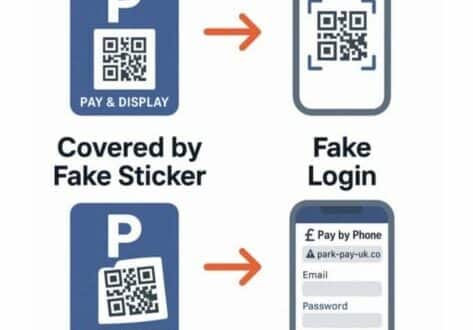
ORDERING in a restaurant, renting a city bike or routinely paying as you enter a train station car park…these are just some of the day to day ways we scan a QR code in Spain.
These innovative payment methods are seen as a way to prevent the spread and transmission of germs in COVID. They save paper while allowing you to pay directly from your phone.
Spain’s Policia Nacional has issued a warning that fake stickers containing QR codes are being used in public areas.
Calling it ‘QRishing’, a classic new form of ‘phishing’ it is allowing conmen around the country – and often, based abroad – to take control of your phone.
The National Institute of Cybersecurity in the country (INCIBE) estimates that the scam has increased enormously over the past few years due to its low price and the difficulty of detecting it.
Action Fraud in the UK claims that the crime has increased 340% from last year, but does not provide any numbers.
And the police body estimates that victims on average are losing £950 (1094 euros), with some cases reaching 45,000 euros when business accounts are compromised.
Action Fraud estimated that by mid-September, there would be over 47,000 victims alone in the UK in 2025.
Maria Rodriguez, a visitor to London on business, was scammed by a man who parked her car in a garage.
She grabbed her phone and scanned the QR code on the payment machine. This routine has become second-nature in an increasingly digitalized world.
This time, it was different. When her camera focused in on the squares of black and white, she felt something was wrong. The URL looked suspicious and the payment screen was slightly off.
Despite running late she decided to contact a cybersecurity helpline – one of many in the UK – that quickly confirmed her suspicions: it was a dodgy one! Do not use it to pay parking!
She searched for an attendant, paid using her card. She was able to avoid a crisis.
In Spain, there are companies that can detect problems quickly.
Cybersecurity is one of them. AnyTech365The company is based in Malaga.
Georgi Medzhidiliev, its Chief Operating Officer, explains that scams are becoming more sophisticated. The QR code fraud is a prime example.
Bad actors know that people are often in a hurry and don’t pay attention when they park. The bad actors only need a few seconds to scan the sticker over the QR code to send us to a fake website and drain our bank account.
“It is a subtle but effective trick. It is catching more and more people by surprise.”
QR Scams: How they work
This scam is extremely simple. Fraudsters put stickers with a false QR code at dozens of locations, including parking meters and electric car charging stations. They also place them on public bike docks, petrol pumps, and even in public bike racks.
Spain’s National Police announced a recent series of cases in Mallorca and Madrid.
Fake codes have been detected in Madrid on BiciMAD bicycle rental stations, and in Palma they were found on electric car chargers.
In Malaga the scammers attempted to trick drivers by putting fake parking tickets on their windscreens. They also included a QR code that directed them to the General Directorate of Traffic’s website.
It was obvious that it wasn’t the official website and, once there were told to pay immediately.
According to a report in the Olive Press from July, the scammers have even used the coat-of-arms of Malaga City Hall for the stickers.
Police have now warned in a series of TikToks and other social media posts that these QR codes are ‘practically identical to the originals’.
“It is difficult for the users to suspect that they are being scammed,” stated a Policia Nacional spokesman.
Before scanning, take a second to think. “A QR code can lead you in the wrong direction.”
The Spanish police in their official warning make clear the following points:
- Check that the QR Code has not been altered. Be suspicious if it appears to be an overlapping sticker or misplaced.
- You can preview the URL on your mobile phone before you access it. You can preview URLs on your mobile phone. Do not follow if the address is different from the official one.
- Analyze visually. The fraudster will usually use low-quality images and spelling errors, as well as aggressive messages to create urgency.
- Avoid installing unnecessary applications.
These scams are particularly dangerous because they imitate legitimate processes. Criminals create fake sites that look exactly like official parking apps and payment portals.

Scammers use victims’ personal information and bank account details to create fake parking apps.
Fake sites are often adorned with professional layouts and fake security badges.
UK hotspots – car parks and restaurant menus as well as retail checkouts, are all prime targets of QR scams.
The Anatomy of a Modern QR Code Fraud
How criminals swap real QR codes with fakes on parking meters—spot the signs before you pay.
Cybersecurity experts are quick in pointing out the sophistication of fraudsters.
Medzhidiliev of AnyTech, who has been working on cyber security in Spain for more than a decade, stated: “It is a perfect storm.” After the pandemic, criminals became more skilled at their craft, and the average user has no way of identifying malicious codes.
Legit vs. fake QR: check the domain carefully—look-alikes trick you into sharing card details.
Criminals use advanced encoding to conceal malicious URLs in codes that look completely normal.
Expert analysis with specialised cybersecurity tools is the only way to be sure that a QR Code is safe.

“You need to contact a cybersecurity expert”, explains Georgi whose company is one of the fastest-growing tech companies in Spain for the last decade. “Time is crucial in these situations, and we can usually solve the problem within five minutes.
“The earlier someone calls for help or advice the better. This will protect them against further damage.” “We’ve seen instances where a quick call prevented someone from losing all of their savings.”
If you have been scammed and need urgent cybersecurity advice, call AnyTech365 for free on (+44) 203 7730 6780 in the UK or 951 203 530 for Spain.
Rapid expert assistance has helped thousands in the UK to avoid losses and secure their accounts.
AnyTech365 is offering a FREE introductory call to any of its services.
CALL NOWAnyTech365 TotalCare: 3 Months FREE
(+34) 951 203 538
(+44) 203 773 6780
Click here to read more Business & Finance News from The Olive Press.