Costa News Spain Breaking News | English News in Spain.

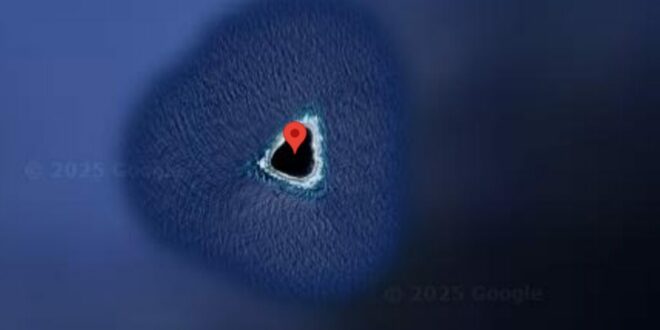
Vostok island, hidden under dense dark-green foliage, was the “black hole” that Google Maps had referred to.
Credit : Screenshot – Google Maps
It started like any other curiosity online – someone zoomed into a random part of the Pacific Ocean on Google Maps and noticed something strange.
A black triangle was perfectly positioned in the middle all of this deep blue water. There was no label or explanation. Just a dark form that seemed to swallow the entire ocean.
In a matter of hours, the image spread across social media. In just a few hours, everyone had a theory. Some people thought it was a military base or black hole. Some thought it was a bug or that Google intentionally blurred out an image we weren’t intended to see. The coordinates — –10.06285840, –152.311076 – became a hot topic for internet explorers. During the time that the internet was guessing the correct answer, experts were also searching for it.
It’s not a hole in an ocean but a hidden island
The truth, as it turns out, is much more down to Earth – literally. This black triangle is not a hole or secret base or alien structure. It’s a small island.
Vostok Island in more detail is a small and uninhabited part of Kiribati. It’s a remote island country located in central Pacific. It is one of the 33 coral islands scattered along the Equator that make up this country.
Vostok is completely black when viewed from space. That’s why it fooled many people. Its vegetation is the reason. The island is entirely covered by Pisonia grandis trees – tall, thick, and dark green – whose dense canopy absorbs sunlight. It looks dark and void from above.
There’s nothing secret about the government or a hole under the sea. It’s just an island that the nature painted in the deepest shade of green possible.
A dark forest with an odd twist
You might think the mystery is over, but you’d be wrong. Those Pisonia trees that make Vostok look so dark have a story of their own – and it’s not exactly cheerful.
The trees produce seeds with a sticky substance that is meant to adhere to feathers. It is nature’s method of spreading seeds between islands. What’s the problem? What’s the problem?
Incapable of flying, they become trapped between the branches where they eventually die. Over time, as the forest floor is filled with the remains and carcasses of birds, it creates a haunting appearance that has earned Pisonia tree the nickname “birdcatcher” trees.
Vostok island is not supernatural but it’s also not your typical tropical paradise. It’s wild, untouched, and strangely sinister – a place where life and death are tangled in the trees.
The viral mystery of the day shows us how curious we are
The story of the island is fascinating, but it’s also how quickly people were captivated by its beauty. In an age when we can explore almost every inch of the planet from our phones, there’s still something thrilling about stumbling across the unknown – even if it’s just a dark shape on a map.
Google Maps, and other apps like GeoGuessr, have made virtual exploration a worldwide pastime. People enjoy the idea of finding out something new and peering at corners of Earth that very few people have ever visited.
And sometimes, as this viral mystery showed, what we find reminds us that the world still has its secrets – and that nature is often far stranger, and more fascinating, than fiction.
Take a closer glance at something you see on Google Maps that does not make any sense. The truth might not be otherworldly – but it could still surprise you.