Costa News Spain Breaking News | English News in Spain.

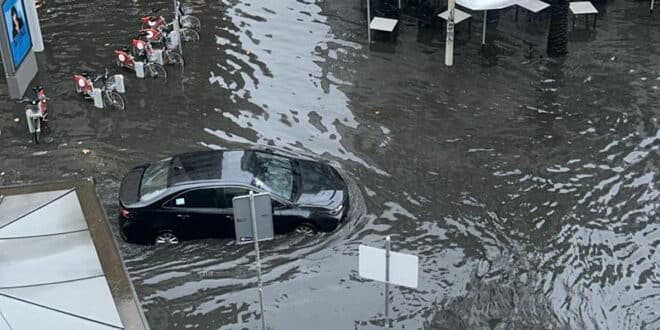
Andalusia suffers severe flooding after storms submerge streets.
Credit X – EMA 111
@E112Andalucia
Andalusia woke up to chaos on Wednesday, October 29 as a violent storm system unleashed torrential rain, tornadoes and flash floods, leaving behind a trail of devastation across Huelva and Seville.
In just a few hours, emergency services reported more than 900 incidents – from flooded roads and trapped drivers to fallen trees and damaged buildings.
The State Meteorological Agency (Aemet) had raised a red alert for Huelva and an orange alert for Seville early that morning, warning residents of ‘extreme risk’. It was evident by midday that the alerts were warranted. Huelva received rainfall of up 160 litres a square metre. It was the heaviest rain in recent years.
Tornado hits Huelva and leaves one man critically injured
Huelva is a coastal region that was hit the hardest by the storm. Residents of up to 12 towns were sent emergency alerts via their mobile phones, urging them to remain indoors while torrential rainfall flooded streets and rivers burst banks.
In Gibraleón, a tornado tore through the town, toppling metal structures and trees. One 53-year old man suffered severe head injuries after being struck by an awning frame that fell. Medics administered CPR before rushing the man to Seville’s Virgen de la Macarena Hospital where he is still in intensive care.
The second waterspout, which ripped through Isla Cristina minutes later, was spotted just off the coast. It was a flood, with fallen walls, power cuts and flooding. Thankfully, no one was seriously injured. Emergency crews evacuated Cartaya’s local school when the classrooms became flooded. Drivers trapped in cars due to rising floodwaters at Ayamonte or Villablanca had to be rescued.
Seville breaks new record for rainfall as transport comes to a standstill
Seville also felt the brunt of the storm. According to local authorities, the city recorded 115 litres rain per square metre. This is a record for rainfall. More than 600 calls for help were made during the deluge, mainly due to flooded homes, broken branches, and blocked roads.
The public transport system was brought to a halt. After power failures on the overhead lines, the C-2, C-5 routes were shut down. Metro services between Amate and Las Platas was also partially closed because of flooding in the tunnels.
Even Seville’s Virgen de la Macarena Hospital wasn’t spared – videos shared on social media showed water cascading down staircases and pooling in corridors. The CSIF union called the condition of the hospital “unacceptable”, saying that a hospital can flood this badly during a storm.
Both the University of Seville (Pablo de Olavide) and the City Council closed all parks and sporting facilities. Electrical problems caused by heavy rain also forced the cancellation of the Motor Show that was scheduled to open in FIBES.
Flooding continues and ferry services are cancelled
In Cádiz, strong winds forced the cancellation of all five ferries between Tarifa and Tangier, while emergency services dealt with flooded basements, damaged roads and fallen power lines across the province.
Authorities have now encouraged residents to avoid unnecessary trips and follow safety guidelines. Andalusian emergency services The emergency number is (112), which continues to receive calls from the affected areas and coordinates rescue efforts.
Although the worst of this storm may have passed, the clean-up will likely take days. According to local officials, it was one of the most intense and recent weather events in Andalusia.