Costa News Spain Breaking News | English News in Spain.

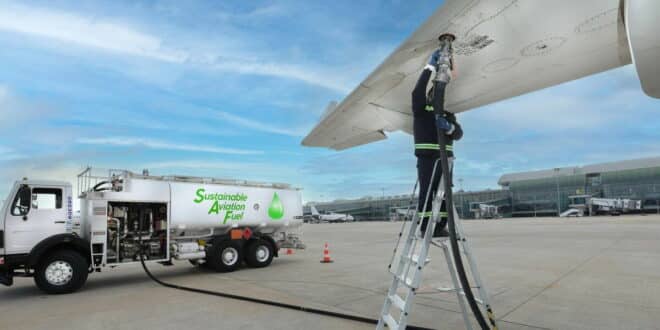
Sustainable Aviation Fuel is used to refuel planes.
Credit: Bulent camci – Shutterstock
In 2029 two green hydrogen fuel plants in Malaga (Spain) will begin producing sustainable aviation gas. This is an important step toward a cleaner air travel.
Repsol leads the €1.5 billion project, backed by EU funding, to deliver 200,000 tonnes of SAF yearly and cut aviation emissions by up to 90 per cent. Located in Axarquía, near Malaga’s airport, the facilities fall in line with Spain’s hydrogen strategy and promise economic growth and job creation.
Project Details and Timeline
Repsol plans to build, in collaboration with Enagas and other partners, two 100-MW electrolysis facilities in Axarquia, Malaga. Construction will begin in 2026 and operations are planned for 2029. The €1.5 billion investment, which includes €300 million from the EU Innovation Fund. supports Spain’s goal to reach 4 GW of electrolysis capacity by 2030 as stated in the PERTE plan.
What is SAF? How is it made?
The plants will use electrolysis powered primarily by solar energy to produce green hydrogen. The hydrogen is combined with captured CO₂ to create a kind of synthetic kerosene, a near-zero-emission fuel. IATA standards state that the process can save 85 per cent of greenhouse gases over its lifecycle. The 2,500 sunshine hours in Malaga each year are expected to reduce power costs by 50%, making it the ideal location.
Benefits to the environment and economy
Green hydrogen SAF could reduce aviation’s carbon footprint by 80 to 90 per centSupporting the EU’s 6 per cent SAF Demanded mix for 2030 Locally, it is said that the project will create 1,500 construction jobs and 300 permanent roles, increasing Malaga’s GDP by €200 million annually, according to an Andalusian impact study. The project will revitalize the area east of Malaga that has been hit by agricultural decline because of a series severe droughts.
Scaling up production: Challenges and solutions
High costs and supply-chain bottlenecks are risks. Electrolysis equipment costs €1,200 per kW, with 20 per cent of components facing shortages. Grid upgrades are required to deal with renewable energy fluctuations, and sudden changes in power flow. These are believed to be the cause of the power outage that occurred in Spain in April 2025. EU policies, such as the €40 billion Hydrogen BankThe private investment burden will be reduced by 40%.
Airline impact and global context
Malaga’s project follows global precedents such as California’s H2@ScaleAccording to the IEA, lower SAF prices, potentially EUR1.5 per litre by 2030, could drive airline adoption and meet rising demand projected at 17 billion litres. Lower SAF prices, potentially €1.5 per litre by 2030, could drive airline adoption and meet rising demand projected at 17 billion litres. Malaga’s ports and airports are close by, which increases export potential.
For the Malaga Province’s economy, potentially this project could give the sustainable move away from dependence on tourism and property investment by capitalising on its natural resources with a relatively low environmental impact – provided, of course, there is sufficient housing ready to take on the necessary influx of skilled workers.