Costa News Spain Breaking News | English News in Spain.



Monday, 29th September 2025 at 19:55
In some way or another, we are constantly reminded of the body. Long hairs, teeth, shoulders and an eye. As Horacio Quiroz says, we are more than just flesh. We are “moulded by” emotions, feelings and experiences. The “things that are not visible” can still have a profound impact on the individual.
Mexican artist Quiroz expresses the “weight of immateriality” through paintings in which the organic and artificial, human and cyborg coexist, creating a creature that is beautiful and grotesque. Quiroz’s first exhibition in Spain takes place at the Galería Yusto/Giner in Marbella from 26 September until 14 November. He admits, “I am excited.”
Seine work is not for the faint-hearted: It “confronts”, directly, the spectator. His characters are strange and disturbing. They invite viewers to ask questions. His mission includes this. He explains, “I am always working with the body and human condition. It confronts and questions you.”
It speaks volumes of him. His art is connected to his search for answers through psychoanalysis and therapies, as well as yoga. He explains, “I’m trying to make people more aware and bring them closer towards self-knowledge. I want to show that the answers do not lie outside of themselves, but are within.”
In a series ranging in size from small to large, Horacio Quinroz (Mexico City 1977) creates hybrid beings, both human and machines, where faces are replaced with rocks. Each rock has a unique shape and appearance. Some look more artificial, while others appear more organic.
“It’s important for each stone to have its own moment of glory, so I use different tools when painting them. Brushes or paintbrushes. Spatulas. By hand. A cloth. “I like the three-dimensionality of their textures and how you can feel them,” says he.
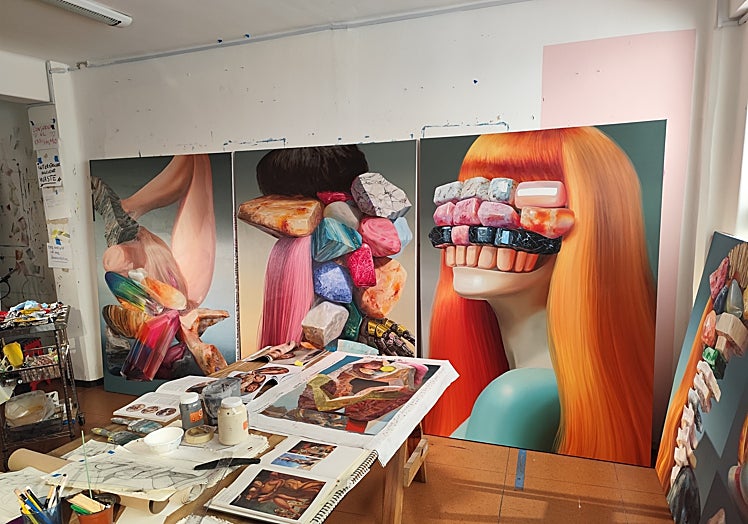
His body is “the place things happen”. His backgrounds are simple and flat to avoid distracting attention from “what happens within” the creature. They are hybrid creatures from a world that blurs genres. Horacio Quiroz explores queerness through the cosmic.
He argues that the first humans on Earth did not label themselves as homosexuals or heterosexuals. There was no binary system where we classify everything so strictly.
El Peso de lo Inmaterial is a curated exhibition by Victoria Rivers that explores the relationship between man and machine. Each piece is based on a sketch Horacio created using his phone whenever inspiration struck him.
Then he works on the image with AI until it becomes the oil painting. In a way, the cyborg and human had a dialogue. It is something that accelerates my process. It’s faster and interesting. The AI will create something for you when you ask. You can then ask again. It’s almost like a ping-pong conversation until I find a sketch I like that I feel can be put on the canvas,” says he.
He is also inspired by scientists and philosophers; he names his paintings after quotes from them. “I was raised in an orthodox Catholic home and my childhood belief system didn’t suit me. I have had to find something to believe in throughout my life. These are phrases I hold dear and have guided me in my life. Here’s an example: “Our machines have a disturbingly active life, while we ourselves are frighteningly inert.”