Costa News Spain Breaking News | English News in Spain.

The British tend to be cautious, which is what Americans would call “risk-averse.”
Spanish cheese might not seem all that appetizing at first. Especially when you find out that it is made with sheep’s dairy. But if you don’t try the cheese of La Mancha (‘queso manchego’), you’re really missing out. It’s available everywhere, and it’s delicious – and cheap – as a ‘tapa.’
La Mancha. This is the land-locked region just north of Andalucía, centred around the towns of Ciudad Real and Manzanares. Its claims to fame are that it’s where Don Quijote was from, it has some ancient windmills, and – of course – it produces cheese. (When you’re looking at cheese in the supermarket, don’t forget that ‘oveja’ means it’s from sheep, and ‘cabra’ means goat.)
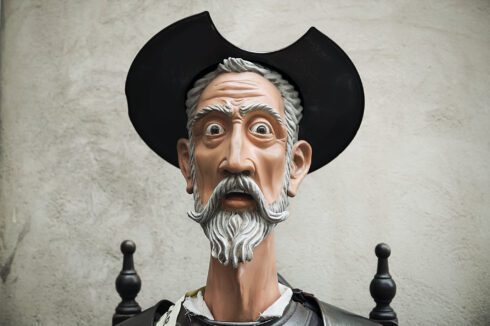
The book “Don Quijote” is often seen by British readers as a bit of a mystery. We don’t understand it. We hear terms like “the founding work of Western literature” or “the first novel”. Part II was published ten years after the first part, in 1605 when Shakespeare was at his peak in London.
READ MORE
Cervantes, the author, set it in La Mancha because the region is a bit of a joke to the Spanish: a central, boring kind of place (just like English people who want to ‘blank’ someone will ‘send him to Coventry’). Don Quijote, a feeble, old man, has been reading too many knightly tales and believes he’s a noble hero. In one of the most famous passages, Don Quijote tries to destroy the windmills in the book because he thinks they are evil.
The beautiful maiden, whom he attempts to protect, is actually a muscular, sweaty peasant woman who carries buckets full of water. If you attempt to read it (and you should – it’s really quite amusing in places), it’s as well to bear in mind that Quijote represents the idealistic ‘dreamer’ side of Spanish (indeed, human) nature, while his servant Sancho Panza stands for our crafty, practical traits.
Now let’s return to the cheese.
By law, ‘queso manchego’ has to mature for a minimum of 60 days, but two years is more normal. Some bars and restaurants refer to it as ‘queso viejo’ (old cheese), which is not very appetising, but attests simply to its maturity.
Manchego cheese is firm, compact, and buttery, with small air bubbles that are unevenly dispersed. The color of the cheese can vary from white to ivory yellow, and its inedible rind can be from yellow to brownish. The cheese has an intense flavour that is not too strong. It’s creamy and slightly piquant, and it leaves a characteristic aftertaste of sheep milk.” Now you know.
Next, you’ll see “D.O.” These letters are crucial: They indicate that the cheese is from La Mancha. “Denominación de Origen” works like the French ‘appellation contrôlée,’ guaranteeing that it comes from where it claims to come from.
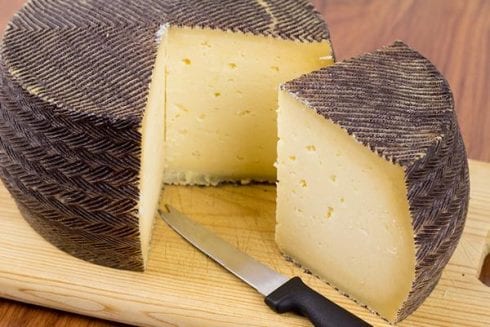
You can imagine that the huge commercial success of cheese from La Mancha will lead to other regions trying to cash in. When you see the “D.O.,” it is a real McCoy. A cheese has to be from La Mancha, and made with milk from local sheep that live on La Mancha farms. The cheese must also (and this is an odd one) be pressed using a cylindrical mould.
There are four varieties of queso Manchego: ‘fresco’ is recently-made, and purists don’t regard it as true Manchego because it hasn’t aged; ‘semicurado’ (half-cured) is a mild cheese which lacks the tang of the real stuff; ‘curado’ is young but firm; and ‘viejo’ is the fully-ripe version with the sharper flavour.
Beware of restaurants that try to fob you off with “queso ibérico.” It’s perfectly edible, but it’s not pure Manchego – it has been blended with the milk of cows and goats. Most Spanish cheeses are “D.O.” label is from La Mancha, and the region exports six million kilograms annually – so they’re doing something right!